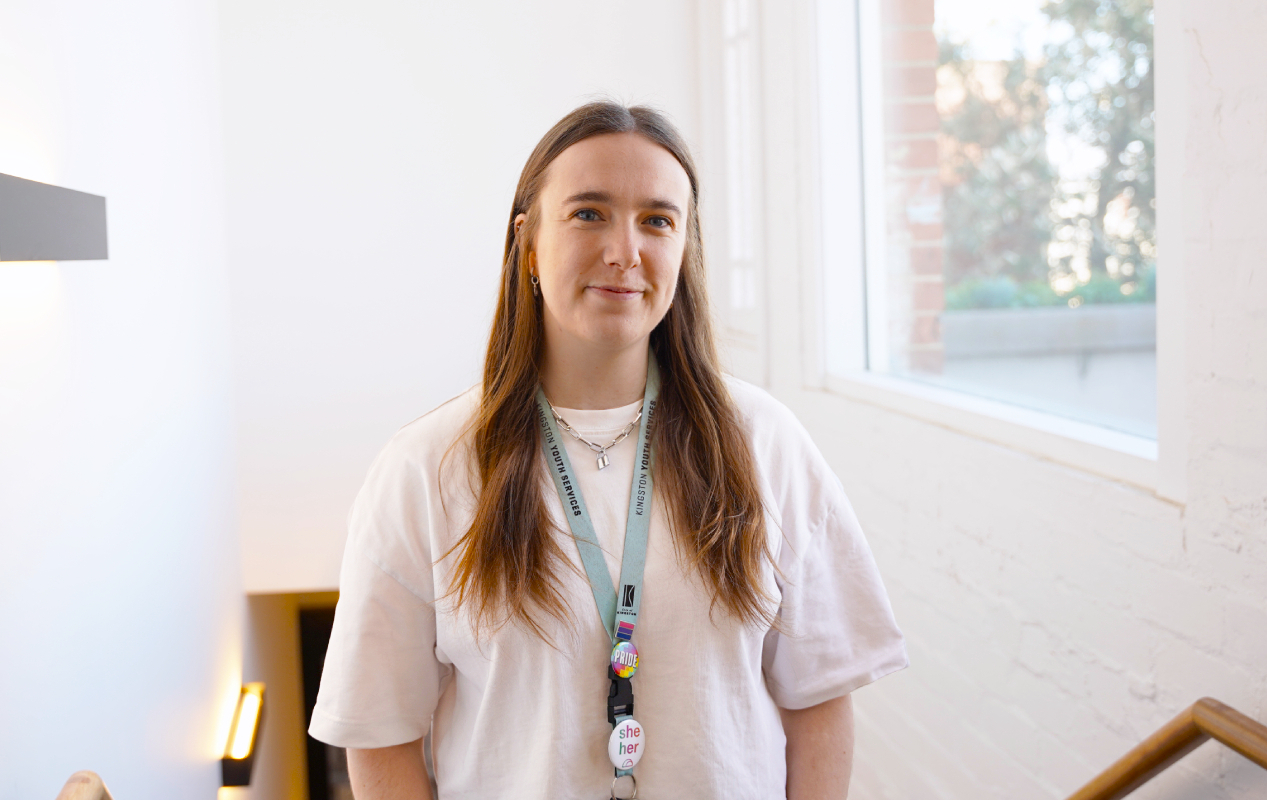
When she’s presenting a school workshop, the first thing Bec Marquis asks is if anyone knows what a youth worker is. Most students don’t (neither do most adults). “We’re not your teacher, we’re not your parent, but we’re here to help support you,” Bec explains.
As a council-based youth worker, Bec’s remit is broad. She sees clients one-on-one, runs school workshops about healthy relationships and life skills, and organises social groups such as Pride Connect and Queer in Kingston.
Bec views her school-based work as preventative – teaching young people social skills empowers them before they even encounter a problem. “Then, if there’s ever an inkling of a problem, they know they can come to us,” she says. “We’re like the GPs of a young person’s world. We help with practical stuff like finding housing, or a job, accessing Centrelink or zhuzhing up a resume, or we can refer young people to things like mental health support.”
Bec discovered youth work when she was 14 and joined a social program run by Kingston Youth Services. “It was my first interaction with a youth worker, and I just thought it was so cool that we could hang out and have honest conversations,” she reflects.
After completing her arts degree, Bec undertook a Certificate IV in Youth Work. The course led to a peer facilitator job with YACVic and a support worker role at a youth mental health recovery and residential service, where she helped young people prepare for independent living.
“That really opened my eyes,” Bec says of her time at the residential service. “Some people didn’t know they could advocate for themselves, to explain that medication they were prescribed was giving them unwanted side effects. To be able to coach them through those experiences or on how to set boundaries with unsupportive parents was really cool. Seeing the impact that support had on them was amazing.”
“As youth workers, we’re like the GPs of a young person’s world.”
While youth work can be similar to social work, Bec sees a key difference in the way youth work centres a young person’s experiences. “We also work with parents and teachers, but the young person is always the primary focus,” she says. “It comes back to that advocacy aspect. When young people learn they have their own personhood and identity, being able to guide and support that is special.”
One of Bec’s proudest moments came from Pride Connect, an LGBTIQA+ social group she co-designed with 18- to 25-year-olds. “There was one young transgender person who, when she entered, was not out,” Bec recounts. “She really wanted to express femininity and was scared to do that, but slowly, over a couple of years in the group, she started dressing more feminine, using she/her pronouns and a new chosen name. By the end, she was fully out to her community. It just made my heart melt, and I totally credit that to the group itself – they are so supportive of one another.”
You can follow Bec’s advocacy work on Instagram @becnellie.
If you're a youth-sector worker and would like to share your story, or want to request a content-related update, get in touch.