It’s becoming more common in the youth sector for young people who were participants in a youth group, committee or service to step into leadership, volunteer roles or paid employment within that same group or organisation.
This can be great youth participation practice and an entry point for young people into a career in the youth sector.
This resource will help you to know what you should expect in the way of safety measures, boundaries and support processes to help you navigate beginning a professional role.
It’s an awesome opportunity to become a leader of a program or group you were a part of, but there are few things you should consider beforehand:
- Consider the time commitment and the details of the role to get an idea if it’s something that you are interested in and have capacity to do.
- If role details are not provided to you upfront, you’re entitled to ask for this.
- It’s important to know how you will be supported and who will be the person supporting you.
This information should be given to you upfront and early in discussions about you taking a leadership role.
If you’re unsure of who to ask, speak to the person who has talked to you about moving into this role, or a trusted staff member who can support you to find ut more.
Leadership can be different for each person, so consider what kind of leader you would like to be and your leadership style.
Consider these questions:
- Are you comfortable speaking in front of a group of your peers and other young people?
- Are you comfortable sharing your lived experience of being a young person or part of a marginalised group?
- How do you feel about advocating for your own needs and the needs and ideas of other young people?
- What are your strengths and weaknesses related to the opportunity you're involved in?
- Is this opportunity related to your values, passions or a cause you’re connected to?
- What is your communication style?
- How do you like to process and learn information?
Remember, you don’t need to be confident in all areas! A leadership opportunity is a great chance for you to grow and develop new skills.
Some organisations are so keen to get young people involved in their work that they get you involved before they are set up to effectively and safely support you.
You should know what to look for in an organisation to ensure they are appropriate and a good fit for you.
Questions to consider
Does the organisation clearly model values of young people’s rights and youth participation?
Does the organisation have clear, safe, ethical practices for working with young people?
- Do they have a Code of Conduct that has clear expectations and guidelines about working with young people?
- Do they have policies and procedures that explicitly function for child safety?
- Do they use the Code of Ethical Practice for the Victorian Youth Sector in their work?
- Do they adhere to the Victorian Child Safe Standards?
- Is there a clearly identified worker or manager to support you in your role?
Will you be recognised or rewarded for your work?
This isn’t always appropriate or needed for the type of leadership role you’re in. Maybe you’re volunteering to get experience for your career or are just happy to help out.
In other cases, you should be paid or recognised for your contribution.
We recommend that if you’re engaging in lived experience or peer work that you seek remuneration for your time.
Has the organisation done work to educate the whole staff team about your role so they understand you are now in a leadership or staff role?
Will they recognise you as a part of the team and treat you equally? This is especially important if you are the first person to be given a role like this.
Am I expected to represent all young people with my lived experience, or all young people generally?
If the answer is yes to either question, this can be tricky and sometimes the organisation may be tokenising you.
It’s important that the work you do with any organisation is done in a meaningful and impactful way, not just for show.
What support or structures does the organisation have in place to support me and other young people?
Sometimes organisations have values and work that you align with but may not have the resources and staff in place to be able to support you effectively or in the specific role they’re offering you.
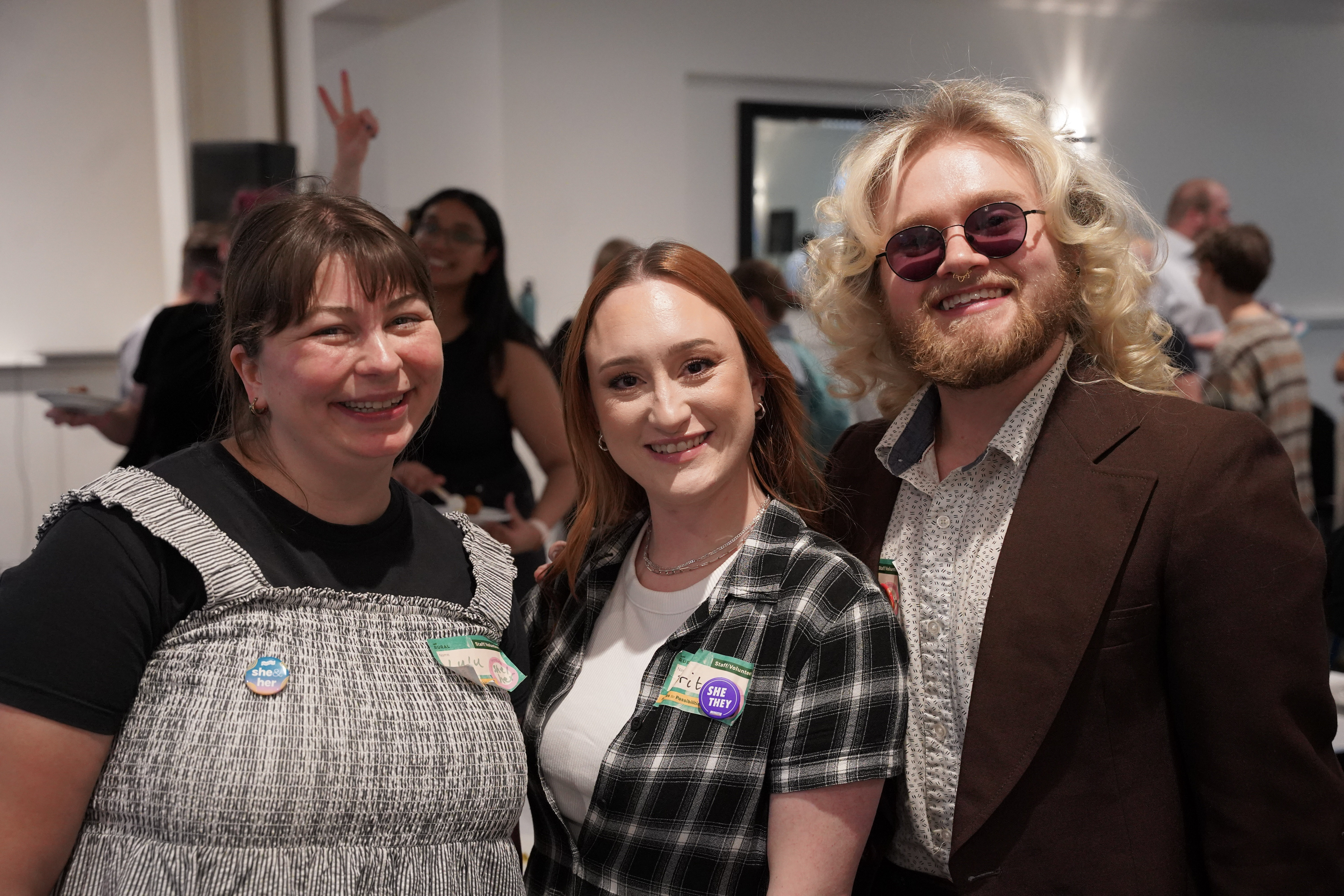
A group of people smiling
If you're working with young people, you’re entitled to specific resources and supports.
These supports include (but are not limited to):
- Access to training and professional development.
- Supervision: this could be monthly or more frequently depending on how often you work in the organisation and with young people in your role. You can also request to have more supervision than you’re currently getting if you need more support or guidance.
- Attending team meetings and have your ideas and opinions heard.
- Having expectations, duties and responsibilities that align with your role and duties clearly communicated to you.
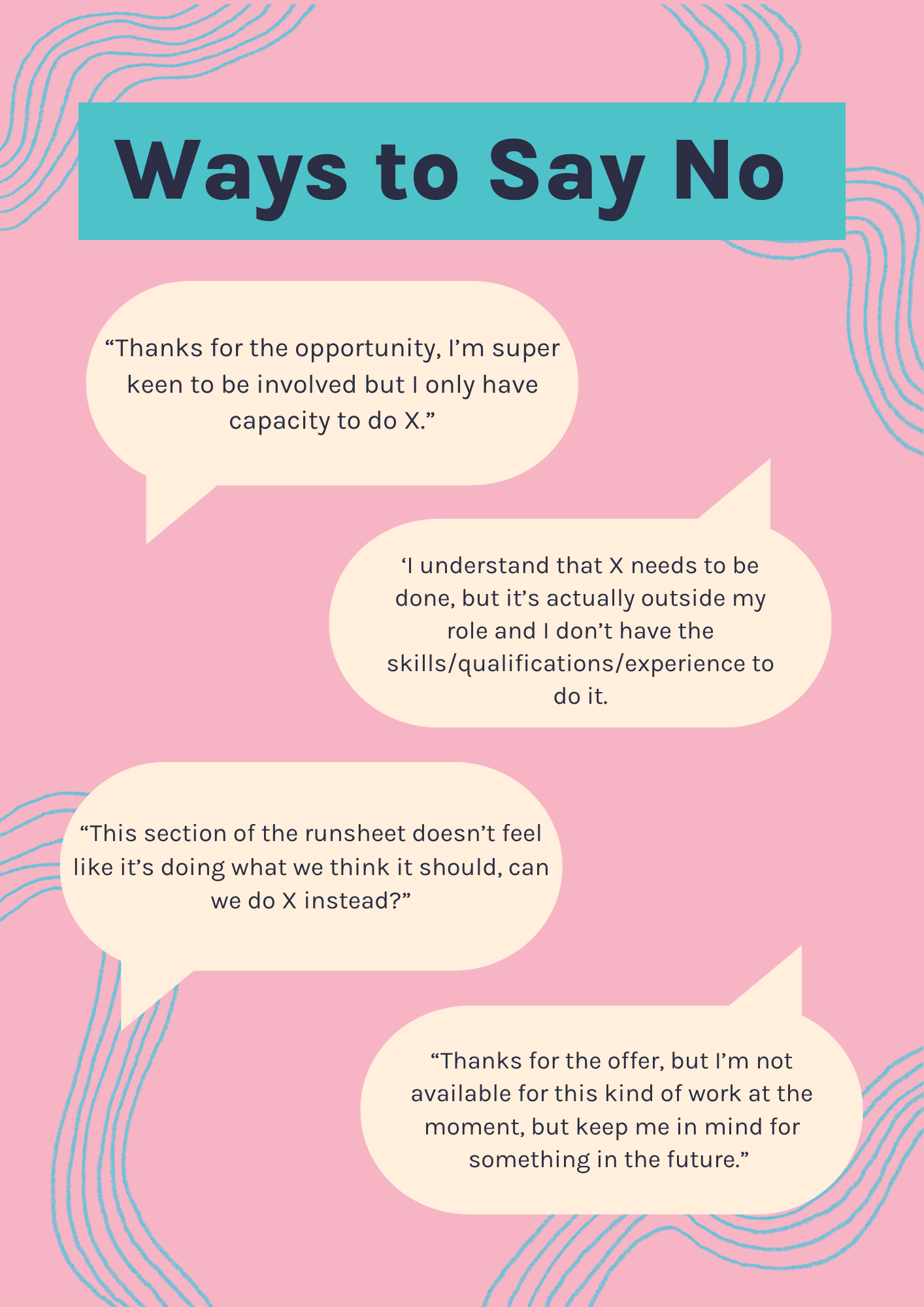
You have the right to say no to duties or questions that are outside of your role or skillset that make you feel uncomfortable (especially if you are concerned about yours or others’ safety), and to voice your opinion about the work you are involved in.
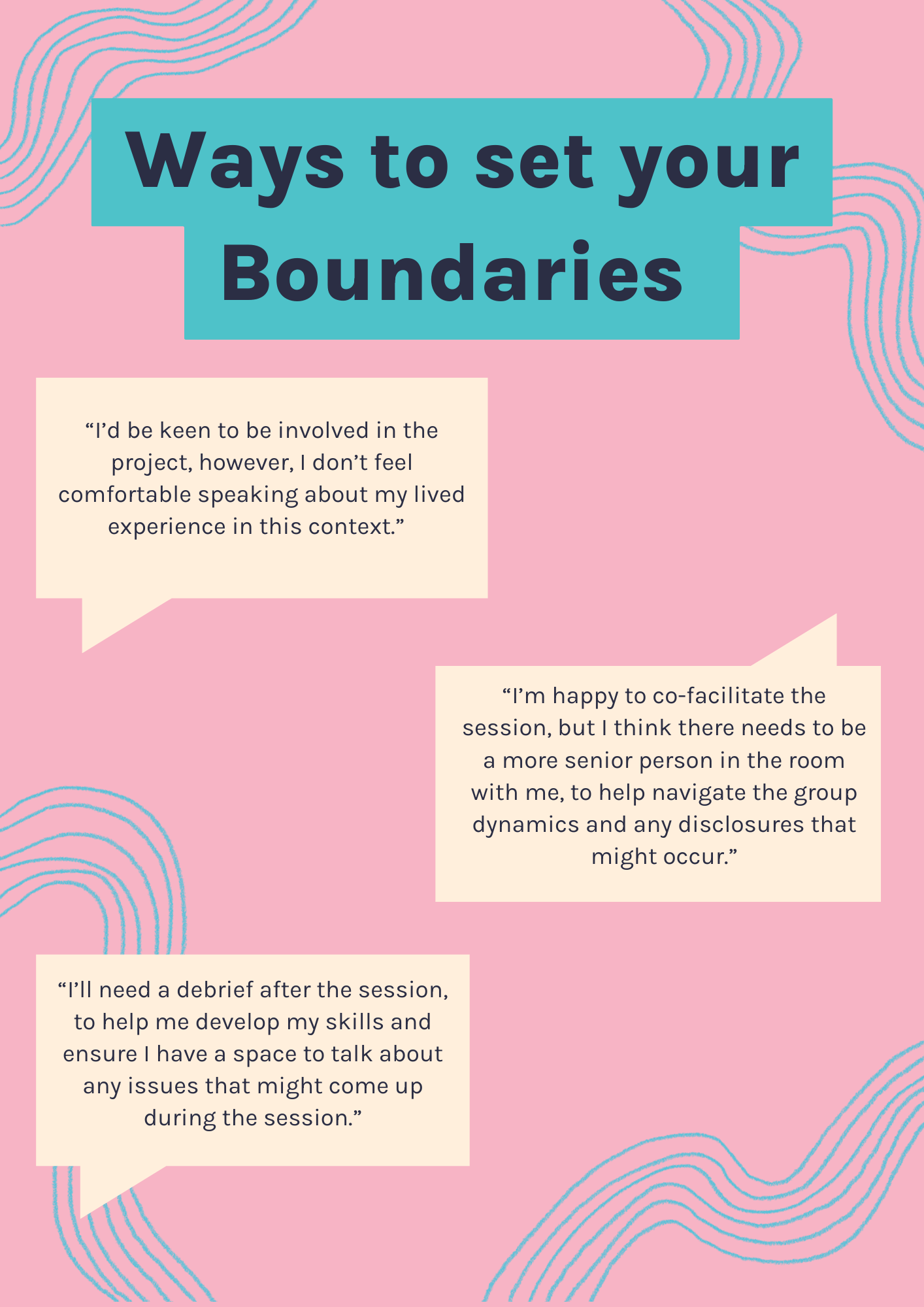
Here's some examples of ways to say no in professional settings.
Suggested scripts of ways to say no
Setting and maintaining boundaries in a professional setting is a crucial skill.
It’s important to think about your boundaries in the early days of your role and be supported by your manager and the organisation to navigate them.
As you move from participant to leadership, the power dynamics will change between you and the other young people in the group.
The organisation you volunteer or work for should have some policies or guidelines about these boundaries. If not, here are some you might set:
- Do not add any of the young people in the group or program on social media (LinkedIn might be different given your role or organisation).
- Do not become friends or engage in a romantic relationship with any young people who attend your group or program.
- You might already be friends with some of the group members outside of your new role. That’s OK, but it's important to disclose this to your manager and discuss if this changes anything about your role.
- If you do have a friend in the group you’re working with, be clear with them that when in the group together you will be acting in a professional way and not treating them as your friend. You need to treat everyone in the group the same.
- You should never be alone with a young person, unless your organisation’s policies say something different.
As a young worker, sometimes young people may see you as more of a friend than a worker. You should establish these boundaries early when working with young people, especially those you may share similar life or community experiences with.
Suggested scripts to say when setting boundaries
Sam
Okay, hopefully everyone can see the presentation.
The presentation is going perfectly, we've just hit record. So what I might do is just introduce and then throw it over to you, Alannah. So, yeah, for those that are here live, and for those that are watching online after the fact, this is a presentation for the Youth Participation Practice Network, from the Crew4Life team at Live4Life. We have Alannah, we have Aaron, Laura and Nathan, who have set up this Alumni Program. And we're very fortunate to have them here today during a spotlight presentation to share a little bit about the journey, a little bit about their challenges and successes of setting up this awesome program. So without any further ado, I'll throw over to you, Alannah.
Alannah
Thank you, Sam. Hi, everyone. My name is Alannah. I'm the youth agent worker at Live4Life. And my role is sending out this amazing alumni group of young, inspirational people called Crew4Life. I'm also zooming in from Gunditjmara country today. And I'd like to acknowledge the elder's past, present and emerging as well. Yeah, so a little bit about Crew4Life. First of all, I'd like to give some background on what is Live4Life. So Live4Life is a Youth Mental Health Promotion charity. We are from regional areas all around Victoria. And we started in the Macedon Ranges.Basically our vision is that rural communities across Australia are empowered to support and invest in young people's mental health, and reduce youth suicide. So our program runs in 11 rural communities all around Victoria, and we are expanding every year. Our program works really closely with communities to ensure that mental health stigma is reduced. The youth Live4Life model is the only mental health model for regional and rural areas for young people.It involves four different parts. The main part that we'll be focusing on today is the Crew, so that the Crew Year 9's and 10's from the regional communities that youth Live4Life is in. They're the youth mental health ambassadors. So they go into the communities run events, and also receive training to increase their mental health skills, and also other skills within their life. So this is where Crew4Life comes in. Live4Life, thought, hey, we have all these amazing alumni that are trained up to be youth mental health ambassadors in their communities. What do we do now. And that is where the Crew4Life came in. So they thought, we have all these amazing skills that we want to continue to develop. And our crew members found the Live4Life program to be amazingly engaging, and they want to keep wanting to continue their journey, as well. So Crew4Life came in. We're an alumni group of young people who were past crew members in Year 10, in that from the Live4Life program. So our Crew4Life members range from 16, to about 26-27. And it's interesting that we spoke before about that 25 year old age range. So we have a lot of past crew members who were in the first ever Crews, who obviously we wanted to remain engaged. So that's why we kept them engaged, even if they're above 25. And so we have 20 young people from all around the state, in our Crew4Life. And I'm very grateful today to have Nathan, Aaron and Laura presenting and also Jayce coming along. These are just a few of our amazing Crew4Life members. So the purpose of Crew4Life was to continue the amazing work that young people have developed while in crew in the communities and in turn, provide them with opportunities to further develop, also to meet people from all around the state. And then also, to use that expertise at youth Live4Life in our organization. And it's, it's been amazing so far, our Crew4Life has been launched for four months. I will play this video from our first founders of crew for life.
(Video plays)
When Maddie and I were doing training in one of the schools and I think we were kind of struggling for a few trainers. And we kind of started having this conversation of Well, where are all our past crews and we have so many amazing young people in our communities that went through Live4Life, join the crew, and then we just kind of lost touch with. It was really exciting to think how many of you are kind of doing the math on you know how many crew members are out there in our community, and in our other communities now as well, that we've have lost touch with. And so Crew4Life adresses this, let's get them back involved, let's see what they're doing. Let's, you know, let's utilize their skills and their knowledge that they've learned and see if you tap into some of those passions that they had when they were in Year 10. And then see what they've done with those passions now, and what that can be utilized for. So Crew4Life is going to be such this important next step in the Live4Life model. And I think, you know, as we've lost touch with so many past crew members, and I think back to even when I graduated school, and you know, losing that structure of high school, and you're hanging out with my mates every day, my mental health really kind of switched a little bit and kind of changed and how I managed, my mental health became harder. So I think it's an awesome opportunity for young people and youth is from 12 to 25. It's, it doesn't stop when you graduate high school. So having this pool of other Crew4Life members who can be ambassadors and can work with us to also do mental health stuff for the whole scope of young people, not just while they're still in school. I think, ultimately, in my opinion, the whole goal of Live4Life communities is that one day, the Live4Live Community is just the community. It's every person, it's every doctor, it's every nurse, every football coaches, every trainee, and I think embolden in these people who have come through the crew to help become champions of mental health within their communities. I think that's how it reached that goal quicker. And I think when we when we hit that goal, at the end, very beautiful.
Alannah
I really love that video, I think it really captures the passion behind why Crew4Life was started. And I really like when Maddie says that the goal is for not just Crew4Life, to be their own community, but for Live4Life to be the community that it is involved in every one every person's life within their communities. It's really exciting. So these are some of the opportunities that we have for our Crew4Life alumni network, I guess. So one of the main things was for our Crew4Life, to have opportunities to meet other members from all around the state who have been through the same program as them. And then also to help plan events and activities, which we're currently in the process of doing. And then also to give further training opportunities. So we have some further training opportunities coming up with our Crew4Life through YACVic, actually, which is the Running Great Workshops Training and the Youth Advocacy Trainings, very exciting. And then also, we wanted our Crew4Life to be involved in in their communities, which is something that they recognize is really important. So being involved in the launch is inductions and celebrations which are within the communities with the crew, which are year 9s and 10s. So being involved in those events, and then also support, support, Yes, speaking. So we have a few opportunities coming up, in spring and other opportunities. And then also, we're in the current position of developing a youth advisory committee so that our Crew4Life can have their voices be heard within the organization. Yeah, and then also formally for our perspective, it also allows us to utilize their skills of the crew within that organization. So it's very exciting. I kind of wanted to talk through some of our planning stages, I think they'll be really helpful, especially when I first came into the position. Forming an alumni group is something that there's not too much out there about how they're formed. There's a lot on youth advisory committees and that kind of thing. But I wanted to share some of the processes that we had to go through as an organization to kind of get Crew4Life on on the road. So our planning stages were really highly involved with our young people. So asking our past crew members, what do you want to do? How do you see Crew4Life? What would you want to get out of Crew4Life, and that was a really important part of the planning stages. We still had contact with a few past crew members who themselves kind of remained engaged in Live4Life. So in those with those contacts, we contacted them and had surveys and that kind of thing. And then also got in contact with other organizations out there. I really recommend talking to other organizations seeing what they have out there. And also, that really helps me in this position hearing tips and planning processes for what other people do as well. That was really important. We also spend a lot of time developing resources on including, like induction packages. So in risk mitigation strategies and policies, and also indemnity forms, making sure our young people feel safe, and that is a safe group and environment. And then also with our budget, it wasn't, too, the parameters weren't too clear on what what like specific goals there were going to be like specific events. So that really left us room to kind of play with how we were going to launch Crew4Life. That was kind of the main main goal of this year to launch and run Crew4Life. So that can be good because it the budget leaves you room to do lots of different things, but also challenging because it were, the options are endless. We also launched on social media, with our comms team, we did a lot of work. And we our Crew4Life helped choose the logo and all that kind of thing as well. But we were really lucky because an alumni group, we kind of already have contact with young people, whereas a lot of youth groups that form kind of a just getting contact without connections. So we were lucky enough to be in contact with communities and spread Crew4Life that way. We also have monthly kickbacks, which are our monthly online meetings, where we all come together and catch up and also plan events and that kind of thing that we're going to do, and also our theme. So we have 20 members at the moment. 20 amazing members, which has been really exciting, especially for our first year. And we have lots of ambitions and goals for the future as well. Yeah, so there's some of the opportunities as well, which I've kind of touched on already with trainings and the meetings and also helping assist with our rebranding, and all that kind of thing. And then also this opportunity, which we are very grateful to be able to present. And then the future as well, we're currently devising the Youth Advisory Committee. And that is a planning work in progress at the moment, because we want to make sure that we do it right. And also preparing the board for young people to come in and have their say, within the organization, which we found really to be really important. And then the crew champions, which is a paid position to to speak at events in the communities because our Crew4Life really want to have an involvement back in their communities. So that's currently a work in progress as well. And now I'm gonna pass over to our amazing Crew4Life members. So I'll let them introduce themselves. First pass over to Aaron.
Erin
Hello, can people hear me. I'm Erin, I believe I'm one of the younger crew members. And, yeah, I joined Crew4Life when Sarah spoke to me about an opportunity. So when it was very early in the makings but I was already on board. I just wanted an opportunity to continue with Live4Life. It's just one of the few organizations that I got to be a part of and really enjoyed working with. And I'm still here so I can continue spreading awareness of mental health and learning about it myself.
Nathan
Thanks Erin. My name is Nathan I am I use he him pronouns. I'm from Benella in North East Victoria. From Yorta Yorta country. I, I joined Crew4Life originally as a Live4Life member in 2017 and 2018. That was when I was in year nine and 10 really enjoyed the opportunity to you know, be what a youth leader in the community and you know, have a positive impact on young people, you know, around the community, really digging into the communities in the schools in Benella, I should say, and having an opportunity to you know, meet new teachers and make some connections with students from other schools as well. And when the opportunity came late last year and earlier this year to you know, come back and reconnect with the crew, and you know, potentially meet other like minded people like me from around the state. I jumped towards that opportunity as well. So that's my intro and I'll pass on to Laura.
Laura
Thanks. Hey, Hi everyone. I'm Laura. She/Her pronouns. I'm originally from the Macedon Ranges live4life communities. So the OG Live4Life Community, which is a bit of flex in my opinion. So I have been involved with live4life for about seven years now, which makes me feel very old. But it's just it's an organization that I'm so so passionate about and has benefited me in so many so many ways over the years, and I just can't wait to see how crew4life can grow into something that continues benefiting our communities and our peers. So it's a very exciting time and program to be involved in. As we continue on, I'd like to just introduce this little video that some other crew4life members have been involved in creating. So a bit of an insight into what crew4life is and why we all love it so much.
Alannah
Hi, my name is Alannah, the youth engagement worker at live4life. And this is our crew4life.
Courtney
My name is Courtney
Charles
My name is Charles Sawyer Bassett.
Josie
My name is Josie.
Erin
I'm Erin.
Nathan
My name is Nathan. I'm from Yorta Yorta country in northeast Victoria from Benella.
Unknown Speaker
Now, why did you join crew4life,
Speaker 6
I joined live4life, originally because I wanted to do something different. And I thought it was important to acknowledge other people's mental health, I then have chosen to stay with crew4life. Because I think once again, it's really important to stay together with like minded people. Communities are all around Victoria, that get to network together week to week, which is really exciting.
Speaker 8
I joined crew4life because I like to talk about mental health. And I'd like to encourage others to do so as well more freely. I joined crew4life, as I thought it'd be an amazing opportunity to rekindle some of the old relationships and connections that I made through live4life originally as both a student and a crew member. I also wanted to give back to my community and be the voice for other young people in my region and get their voices heard towards different organizations and individuals that would help out the community for the better.
Speaker 5
I joined crew4life to continue being able to be the organization that helps support teams with mental health, I keep learning new things, and I'm able to teach other people. And I'm glad I had the opportunity to continue to further improve my knowledge and my ability to help others.
Speaker 9
I recently joined the crew last year, to join a group of people who are like minded and all working towards the same goal.
Alannah
What is one word you would use to describe crew4life?
Speaker 8
a value that I'd use to describe crew4life would be community as it allows for everyone to feel a sense of belonging and allow everyone's voices to be heard no matter who they are. And to get their thoughts and opinions through to both the council and other organizations.
Speaker 9
One value I would use to decribe crew4life is collaborative. We all work together, and everybody's ideas are respected.
Speaker 6
And you know, I got to say one thing about crew like it's really important. It will be you know that everyone cares about one another. We're all we're all there with a similar purpose. We've all been through different walks of life, but we all end up back on at monthly meetings catching up and meeting one another. So it's really great.
Speaker 8
A value I think for crew4life that has especially is communication. Because communication is key in this topic that we base ourselves on mental health.
Speaker 5
A value of crew4life, I'd love to put unity or togetherness, it's really just everyone working together to accomplish something great.
Alannah
I love that video. I feel like we might have already shared but introducing crew4life did Nathan, Erin, and Laura would you like to say more on that?
Unknown Speaker
Erin, you can go first.
Unknown Speaker
I think I think I've summed it up pretty much.
Nathan
I'll jump in with a little bit more on that topic. So you know, some obviously some benefits that you can get from from Crew4Life, you know, we're getting the opportunity to do you know, some more public speaking, we're getting the opportunity to show our communities that you know, youth can be leaders, you know, in the community and with what we do. We we work on inclusion and friendships and making sure that we have you know, long lasting relationships in those communities and with one another and you know, you you stick around because you you crave those things in regional communities, you know, you don't have a whole lot of opportunity to, you know, network and potentially make friends or, you know, acquaintances with like minded people and by staying in this organization and you know, we get to do exactly that. And the funding I think is really important for crew4life and it's great that live4life has been able to bring this into fruition and we're looking forward to seeing you know where it goes in subsequent news from here.
Laura
Given that I wasn't a part of that video because I forgot to send mine in I feel like I have plenty to say about it. But I think the really important thing to take away from any presentation that discusses live4life is the impact that it has on communities and on individuals as well. So, I've often shared my story with live4life, because I'm so passionate about it. And because of how personal it is, to me, I've always said that, you know, the reason I volunteer, every opportunity I get is because live4life saved my life, I wouldn't be here today, and I wouldn't be the person I am today without with live4life. And I think that crew4life is just an extension of the work that live4life is already doing in communities. And I think that it's an opportunity for young people to have their voices heard. But also, you know, people like me, who struggled so much in high school, with their mental health. And finally, like, for once had the opportunity to share, you know how tough it was, but also how valuable a program like live4life was, because it gave me the tools to be able to ask for help. More importantly, it gave my friends, my peers, the tools to be able to notice when things weren't right with me, and be able to actually reach out, you know, to teachers or well being and say, Hey, can someone check on her because she's not okay. And I think that if we can take that knowledge that we've learned in Live4life, bring it to crew4life and continue spreading that message. Who knows how many lives we could save, because we know how big of an issue mental health is, and the more people that are talking about it, the better. So I stayed, because live4life saved my life. And hopefully, we can, you know, spread the message and just make sure that everyone is getting the help that they need. Thank you all to our goals. Alannah, if you want to jump in?
Speaker 5
Yeah, let me just pull up my notes again. So goals for crew4life. We wanted to create more discussion and awareness on mental health, and the stigma that surrounds that mental health is all bad, and we can't talk about it. We also want to create a community that contributes to a multifaceted approach to mental health. So we just want to be able to say helping more than one to educate ourselves and others and for life, we want to continue improving, and continue improving the lives of others as well. So those are a few of our main goals for crew4life.
Speaker 7
Having goals means that we obviously want to achieve those goals. So some of those ways we want to achieve our goals as crew4life is about having really open and honest discussions. So Alannah and I spoke about our kickbacks that we have monthly. That's an opportunity for a group of like minded people to get together and share their experiences and share their knowledge, and continue having these really important discussions about mental health and how, you know, we can continue to educate our communities, and our friends and our families. We know that young people want to talk and be involved in discussions regarding issues that matter to them. Mental health is one of those issues. It has a huge impact on young people, and they want to be involved in that discussion. So this is just an opportunity to be able to include the views of young people in that discussion regarding mental health. Another way that we can continue to share our messaging is community events. So hopefully there'll be the opportunity in coming months and coming years that we can get out into community participate in community events. And again, just continue spreading the message. The other thing possibly one of the most important things that we're going to do to achieve our goals is utilize lived experience. So just making sure that you know those who have experienced mental ill health, those who have experienced tough times or the effects that mental ill health can have on a on a broader community are being heard and their experiences are being listened to so that we can make sure that anything that is done in this in this area is done with in mind with those in mind who have actually experienced already and know know the truth about you know how tough it can be and also what's most important when it comes to moving forward.
Speaker 6
Continuing on, from what Laura said, on discussing, why do we want to see change in our communities, and Laura was talking about young people wanting to be a part of the change, you know, wanting to be heard. And I think that there's no better way for a message to be shared with young people, then by having, you know, like minded people of the same sort of age, you know, trying to share that message with youth, well, you know, it comes across very well, if it is coming from you, we want we want change, so we can feel a sense of belonging in the community, make sure that those that in the community are struggling know that there are others who can support them, and where, where they can go for help in the community as well. We want to obviously, our overall aim is to reduce the stigma around whether that's young people, older people, you know, members of the community that have a stigma around mental health, and, you know, talk about talk about in real terms, we want to make sure that everyone feels comfortable to go out and, you know, tell people how they're feeling and you know, that can be respected in the workplace, in their sporting grounds, all that sort of thing. We want to reduce stress and harming in the community of young people, obviously, it's important that this message gets across the whole community. But if we can start with the young people while they're in school, and while they're learning vital messages and stuff, it's I think, it's really important that we can share that message, you know, to the youth. Seeing a change in the community also motivates us. So we've had a lot of people go through youth live the life through year nine and 10. And now you know, crew for life started, we can really see how long it how much of an impact it's had, and we're going to have a chain of people right through or of all different ages that you know, continue to share the same sort of message. So we will know we'll see a change in our community, you know, you could have someone from live for life, you know, in your work in your school, in your classes that you do as well. And there could be people that have been part of this movement that you know, are part of community change. And then from there, we'll spread it, not only through all of Victoria, but you know, it'll end up in different states, you'll run into people down the track of venture that have done this program. So you have to start a real big community change and a big movement.
Speaker 2
Think Erin's, Erin's glitched out of it. That's okay. So now we're going to talk about our theme, which is what we've come up with as a group for what represents our group curricula. So with Nathan or Laura, would you like to go ahead?
Speaker 6
I'll start with the first part of just Why'd we choose it. So obviously, our our theme that we've all chosen as a group was joined the community and continue in unity. So obviously, live4life is built around community participation, and we wanted to make sure that everyone who sees our theme know straight away, you know, what we're about and what we're trying to do. So obviously, you know, we want you to join our community of crew4life, and, you know, continue to continue in Unity. So you want everyone in the, to feel that they are involved, invited to come in and, you know, continue to working towards the same common goals we spoke about before, it adds on to the message that youth live4life is trying to do in schools, in the nine and 10, they have a theme that they pushed in each community every year, something that they work towards that the you know, and nines and 10s, you know, get to develop their skills on. So it helps build to this. And most importantly, it rhymes. So we'll be able to people remember it, and you know, you can think of it up off the top of your head because it runs quite well.
Speaker 7
And finally, why is it important to us? And I think really, we've probably covered it today already. But community is a welcoming space for everyone. And that is exactly what we want crew for life to be. So that's why it's so important. We want people to feel welcome. We want people to feel comfortable. So then we can, you know, have those honest, open conversations regarding mental health and find the best way forward for our communities to be able to discuss mental health and support our young people. So that's the main thing and of course, it does rhyme so why wouldn't you want to be involved in a group that has a rhyming theme? Because obviously, important stuff? Very true.
Speaker 2
I'm not sure if Erin's okay, but um, yeah, thank you so much, Erin, and Nathan, and Laura, you've been like such integral parts of crew4life. And I feel like I couldn't have summed up what you said better. So thank you so much for coming along today and sharing your experiences and it's really appreciated. Thank you so much. And I know that I'm aware of time, but I just want to quickly touch on Some are like the challenges and key learnings just quickly for like a minute as I spoke in my little breakout room before, but one of the big challenges for getting that crew4life up and running was, I guess, under-estimating the investment that actually takes to run and alumni group, it's a really personal thing to have connections with these amazing young people one on one. So that's kind of why they pop me into the role for three days a week, to focus on the crew4life and getting it up and running off the ground or initially launched in 2021. But there just wasn't enough time to fully commit to what it could be. The idea was always there was always so exciting, but it just wasn't, we just weren't able to do it based off one day back in 2021. And also another challenge is that even though we do have over 900, past people from who were in the crew, it challenged us to get engaged with all those people, especially because it all around the state with different community, workers and leaders. So that was another challenge to to for our past crew members to learn about what crew4life was and then also to distinguish between doing it in their communities to then doing it in a group where it's like people from all around the state. And then also the planning challenges we were tossing up between whether to have and our teams involved. So we decided, yes, that's so important, because people finish your turn, we want them to roll on and continue. So the planning process in getting that up and running was, you know, working with children's checks for those who are over 18 parents or permission throughout the whole process. So keeping parents in the loop, contacting them as well. And then also just going through, you know, child safety policies and all that kind of thing. But some of our key learnings would definitely be to do it, to do it right from the start. So do your planning stages, ask the questions to the young people get them involved in what they want, what they want the group to look like, and what they would like to do, contacting other people who have already started alumni or other groups out there as well. Also, just to trial things, like talking about things and planning is great, but actually doing it is different. So it's all about just giving it a go, trying things out getting the feedback from the people that are in your alumni, whether they liked it, or they didn't like it. But I think for my experience, it's just been about like trial and error just going for it because you never know. And yeah, it's also important to build connections with the alumni, people want alumni members one on one as well. Because, you know, it's so important to have a group where they can feel safe and also able to reach out to myself or even the organization in general. But yeah, that's, that's it. And here's my contact details if you'd like to contact me, and thank you so much to Erin and Nathan and Laura, and also Jayce for attending. And just want to open up and see if anyone had any questions.
Sam
I might just jump in Alannah. We're very close to running out of time. So what we might do is do the q&a via the chat box if you're happy to do that.
Yeah. Awesome. Thank you so much, Alana, Nathan, Laura, Erin, and Jayce. And to those who created the video that we shared today, as well. You've all taken time out of your day to come along and share your journey. It's not easy stepping into a room full of faces, and speaking up. So a massive, massive props and thank you for pushing yourselves to do that today. You can see that there's a lot of love in the chat, as well as all the reactions and emoticons that are going up on people's screens as well. So yeah, massive thank you to you all. And if you're catching this online and watching it on YouTube, please have a look in the description box for links to join the YPPN so that you can take part in these future conversations. Alright, we can wrap up there.
Youth Live4Life's Crew4Life program is where young people who are A person who has attended or has graduated from a particular group, program, school or universityalumni of the Live4Life program are engaged as guest speakers, continual training and skill building and plan events and activities.
This is a great example of how young people have transitioned from participants in the Live4Life program to leadership roles at Crew4Life.